

Choosing what to study after completing Grade 12 is one of the most important decisions in a student’s life. The course you select can influence your skills, professional opportunities, earning potential, and future study options. However, with so many academic and professional programs available, selecting the right one can feel confusing.
The best courses after +2 in Nepal include Chartered Accountancy, BBA, BCA, engineering, medical and health sciences, hospitality management, law, information technology, and different professional programs. The right choice depends on your interests, academic background, budget, strengths, and long-term career plans.
Students are more likely to build a rewarding future when they select a course that suits their interests, practise useful skills, and learn through internships or other real workplace experiences.
Most Popular Courses After +2 in Nepal
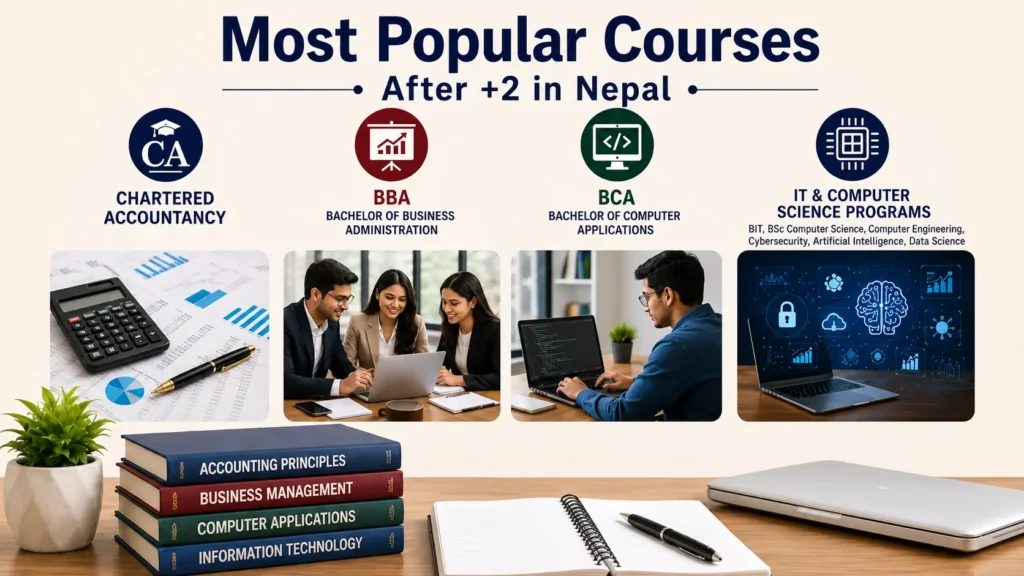
Nepal offers academic degrees, professional qualifications, and skill-based programs for students from Science, Management, Humanities, and other streams.
Some courses provide a direct professional pathway, while others offer broader academic knowledge and multiple career options. Here are some of the most popular courses students can consider after completing +2.
Chartered Accountancy
Chartered Accountancy is a professional course for students interested in accounting, auditing, taxation, finance, and business management. It can be suitable for students who enjoy working with numbers, financial statements, business laws, and problem-solving.
Students who complete Grade 12 or an equivalent qualification can enter the Chartered Accountancy pathway through the Foundation Level under the current ICAN structure. ICAN’s professional course progresses through different stages that build knowledge in accounting, taxation, auditing, finance, law, and professional practice.
Students interested in this pathway can also seek academic guidance from established CA education institutions such as Prime CA. Proper classroom support, regular exam preparation, mock tests, and guidance from experienced teachers can help students understand the course structure and prepare more effectively for different levels of the CA examination.
CA students can build careers in areas such as:
- Accounting and financial reporting
- Auditing and assurance
- Taxation
- Banking and finance
- Business consulting
- Risk management
- Corporate finance
Chartered Accountancy requires discipline, patience, and consistent study. The examinations can be challenging, but the course can provide a focused professional pathway for students who want to enter the accounting and finance sector.
It may be especially suitable for students who are prepared to follow a structured study plan and develop both technical knowledge and practical experience. Before joining, students should understand the syllabus, examination system, training requirements, and expected study commitment.
Bachelor of Business Administration
The Bachelor of Business Administration (BBA) is a popular management degree. It introduces students to marketing, accounting, finance, economics, human resources, operations, entrepreneurship, and business communication.
Kathmandu University offers a four-year BBA program that focuses on building the knowledge and skills needed for business management and entrepreneurship.
BBA can be suitable for students who want to work in:
- Banks and financial institutions
- Marketing and sales
- Human resource management
- Business operations
- Project management
- Entrepreneurship
- Corporate administration
Since BBA is a broad degree, students should not depend only on classroom learning. Building practical skills through internships, presentations, case studies, software training, and professional networking can improve its career value.
Students who actively participate in projects and gain practical exposure during the course may find it easier to understand how businesses operate in real working environments.
Bachelor of Computer Applications
Bachelor of Computer Applications, or BCA, is suitable for students interested in software, programming, websites, databases, mobile applications, and information systems.
Tribhuvan University’s BCA is a four-year program divided into eight semesters. The program helps students develop computer-related knowledge and practical abilities to address technological needs in business and other professional sectors.
Common career options after BCA include:
- Software developer
- Web developer
- Mobile application developer
- Database administrator
- System support officer
- Quality assurance professional
- IT project coordinator
The technology field changes quickly. Therefore, students should practise coding, create projects, develop a portfolio, and learn current tools instead of depending only on classroom lessons.
Practical projects can help students demonstrate their skills to employers and understand how software and digital systems are developed in real situations.
Information Technology and Computer Science
Students interested in technology can also explore BIT, Computer Science, Computer Engineering, Cybersecurity, Artificial Intelligence, and Data Science.
Kathmandu University currently lists undergraduate options such as BIT, BSc Computer Science, Computer Engineering, B.Tech in Cybersecurity, B.Tech in Artificial Intelligence, and Bachelor of Data Science. Course availability and admission requirements differ between institutions.
These programs can lead to careers in:
- Software engineering
- Data analysis
- Cybersecurity
- Cloud computing
- Artificial intelligence
- Network administration
- Product development
Technology courses are best suited to students who enjoy logical thinking, continuous learning, and solving technical problems.
Because technology keeps changing, students should be ready to update their knowledge even after completing their degree. Certifications, internships, personal projects, and practical training can support long-term career development.
Career-Oriented Courses with Strong Job Prospects

Many students search for career options after +2 in Nepal because they want a course that can lead to employment. However, no degree can guarantee a job.
Employment depends on several factors, including the course, institution, practical skills, work experience, industry conditions, communication ability, and the student’s individual effort.
The following fields can provide useful career pathways when academic learning is supported by practical experience.
Accounting, Banking and Finance
Students interested in finance can consider CA, ACCA, BBA Finance, BBS, BBM, economics, or banking-related programs.
These courses can support careers in:
- Accounting
- Auditing
- Commercial banking
- Insurance
- Investment services
- Financial analysis
- Taxation
- Corporate finance
Students should also learn spreadsheet tools, accounting software, financial reporting, business communication, and data analysis.
These practical skills can make academic knowledge more useful and help students prepare for internships, entry-level positions, and future professional responsibilities.
Software and Digital Technology
Technology is no longer limited to software companies. Banks, hospitals, schools, government offices, retailers, media companies, and other organisations use digital systems in their daily operations.
Students can prepare for technology careers through BCA, BIT, Computer Science, Computer Engineering, Cybersecurity, or Data Science.
A degree provides the foundation, but employers may also look at practical ability. Personal projects, internships, coding competitions, open-source contributions, and an online portfolio can help students demonstrate their skills.
Students should focus on both technical ability and communication skills because many technology jobs involve teamwork, client communication, planning, and problem-solving.
Professional Courses for Faster Career Growth
Professional qualifications focus on particular industries and career paths. Some can be studied instead of a traditional degree, while others can be completed alongside one.
These courses can be useful for students who already have a clear career direction and want specialised knowledge.
Chartered Accountancy and ACCA
CA and ACCA are popular professional courses after +2 for students interested in accounting and finance.
The Institute of Chartered Accountants of Nepal administers CA in Nepal. Students planning to follow the ICAN pathway can explore CA preparation institutions such as Prime CA for academic guidance, structured classes, examination preparation, and support during different stages of the course.
ACCA is an international professional accountancy qualification, and students can study through approved learning providers available in Nepal.
Both pathways require serious study and exam preparation. Students should compare:
- Course structure
- Registration requirements
- Exam format
- Training requirements
- Total fees
- Recognition
- Intended career location
Students should not choose between CA and ACCA based only on which one appears easier. They should consider where they want to work, what type of accounting career they want to build, and which qualification better supports their long-term goals.
Speaking with current students, qualified professionals, authorised institutions, and experienced academic counsellors can also help students understand the differences more clearly.
Steps for Selecting a Course That Matches Your Goals

After exploring academic and professional options, students should compare them according to their personal goals. Students wondering what to study after +2 in Nepal should begin with self-assessment because there is no single course that is best for everyone.
A course that suits one student may not suit another. The right decision should be based on personal interests, academic strengths, financial situation, learning preferences, and long-term career goals.
Understand Your Interests and Strengths
Consider the subjects and activities you naturally enjoy.
Ask yourself:
- Do I enjoy numbers and financial analysis?
- Am I interested in computers and technology?
- Do I like science and healthcare?
- Am I comfortable speaking and working with people?
- Do I enjoy designing or building things?
- Do I prefer academic study or practical work?
Interest alone is not enough, but it can help you remain motivated during a demanding course.
Students should also think about their learning style. Some courses require regular theory-based study, while others involve practical projects, laboratory work, presentations, or professional training.
Check Eligibility and Entrance Requirements
Every program has different requirements. Science-based programs may require particular subjects, grades, or entrance examinations. Professional qualifications may have their own registration and exam systems.
Always check current information from the university, professional body, college, or responsible authority instead of depending entirely on social media posts.
Students should confirm:
- Minimum academic requirements
- Required subject background
- Entrance examination details
- Registration deadlines
- Required documents
- Admission process
Checking these details early can help students avoid missing deadlines or applying for a course they are not eligible to study.
Compare Course Duration and Total Cost
Course expenses include much more than the amount charged for tuition. Students should also consider:
- Admission and examination fees
- Books and study materials
- Transportation or accommodation
- Technology and equipment
- Professional registration fees
- Internship-related expenses
A more expensive course is not automatically better. Students should compare the curriculum, faculty, practical training, recognition, student support, and overall learning environment.
Families should also discuss whether the course cost is manageable throughout the full study period, not only during the first semester or first year.
Research the Career Scope
Look beyond the name of the degree. Research what graduates actually do after completing it.
Review job vacancies to understand:
- Required qualifications
- Common technical skills
- Experience expectations
- Available job roles
- Typical work environment
Conversations with working professionals and newly qualified graduates can give students a clearer picture of the field and its day-to-day demands.
Instead of asking only whether a course has good scope, students should ask what skills are needed, how competitive the field is, and what entry-level career opportunities are usually available.
Check Recognition and Affiliation
Before paying an admission fee, confirm that the college and course are recognised by the appropriate university, council, professional body, or government authority.
Recognition is especially important for medical, engineering, technical, and professional courses.
Students should not depend only on advertisements or verbal promises. They should check official sources and ask the institution to explain its affiliation and recognition clearly.
Review Practical Learning Opportunities
A good course should help students apply what they learn.
Look for:
- Internships
- Laboratory work
- Industry projects
- Case studies
- Field visits
- Presentations
- Career counselling
- Placement support
Practical exposure can help students understand the workplace and become more confident before graduation.
It can also help them identify which area of the field interests them most and which skills they still need to improve.
Avoid Following Friends Blindly
Your friends may have different strengths, budgets, interests, and career goals. Joining the same course may feel comfortable at first, but it can create problems if the field does not suit you.
Choose a course based on your own research and long-term plan.
Friends can support each other during the decision-making process, but the final choice should be personal and based on individual career goals.
Frequently Asked Questions
-
Which course is best after +2 in Nepal?
There is no single best course for every student. CA can be suitable for accounting and finance, BCA or BIT for technology, engineering for technical careers, and health science for healthcare. The right option depends on your interests, eligibility, budget, and career goals.
-
Which course has good career scope in Nepal?
Accounting, information technology, healthcare, engineering, finance, hospitality, and other professional fields can offer useful career pathways. Career scope also depends on practical skills, experience, market demand, and individual performance.
-
What can Management students study after +2?
Management students can consider CA, ACCA, BBA, BBM, BBS, economics, hotel management, law, banking, finance, marketing, and selected IT programs. Eligibility differs between institutions.
-
Can students study CA after completing +2?
Yes. Students who have completed Grade 12 or an equivalent qualification can apply for the CA Foundation pathway, subject to the latest eligibility and registration rules issued by ICAN. Students can also seek guidance from CA preparation institutions such as Prime CA to understand the course structure and examination process.
-
Is a bachelor’s degree better than a professional course?
A bachelor’s degree provides broader academic knowledge, while a professional course focuses on a particular career. Neither is automatically better. The right choice depends on the profession you want to enter.
-
Are short-term courses enough to get a job?
A short course can introduce practical skills, but completing the course alone may not be enough. Students usually need regular practice, a portfolio, communication skills, internships, or real project experience.
-
How can I choose a college after selecting a course?
Compare affiliation, recognition, faculty, curriculum, fees, facilities, internships, student support, and location. Visit the college and confirm important details before making payment.
Conclusion
The best courses after +2 in Nepal include academic degrees, professional qualifications, and practical skill-based programs. Students can explore fields such as Chartered Accountancy, business management, information technology, engineering, healthcare, hospitality, law, and creative services.
A popular course does not guarantee a successful career. Students should choose a program that matches their abilities, interests, financial situation, and long-term plans. They should also develop practical skills, gain experience, and continue learning beyond the classroom.
Students who are specifically interested in accounting, auditing, taxation, and finance can explore Chartered Accountancy and consult trusted CA education institutions such as Prime CA for proper course guidance and examination preparation.
Take time to compare courses, verify eligibility, research institutions, and speak with experienced professionals. A careful decision after +2 can give you a clearer direction and a stronger foundation for your future career.