
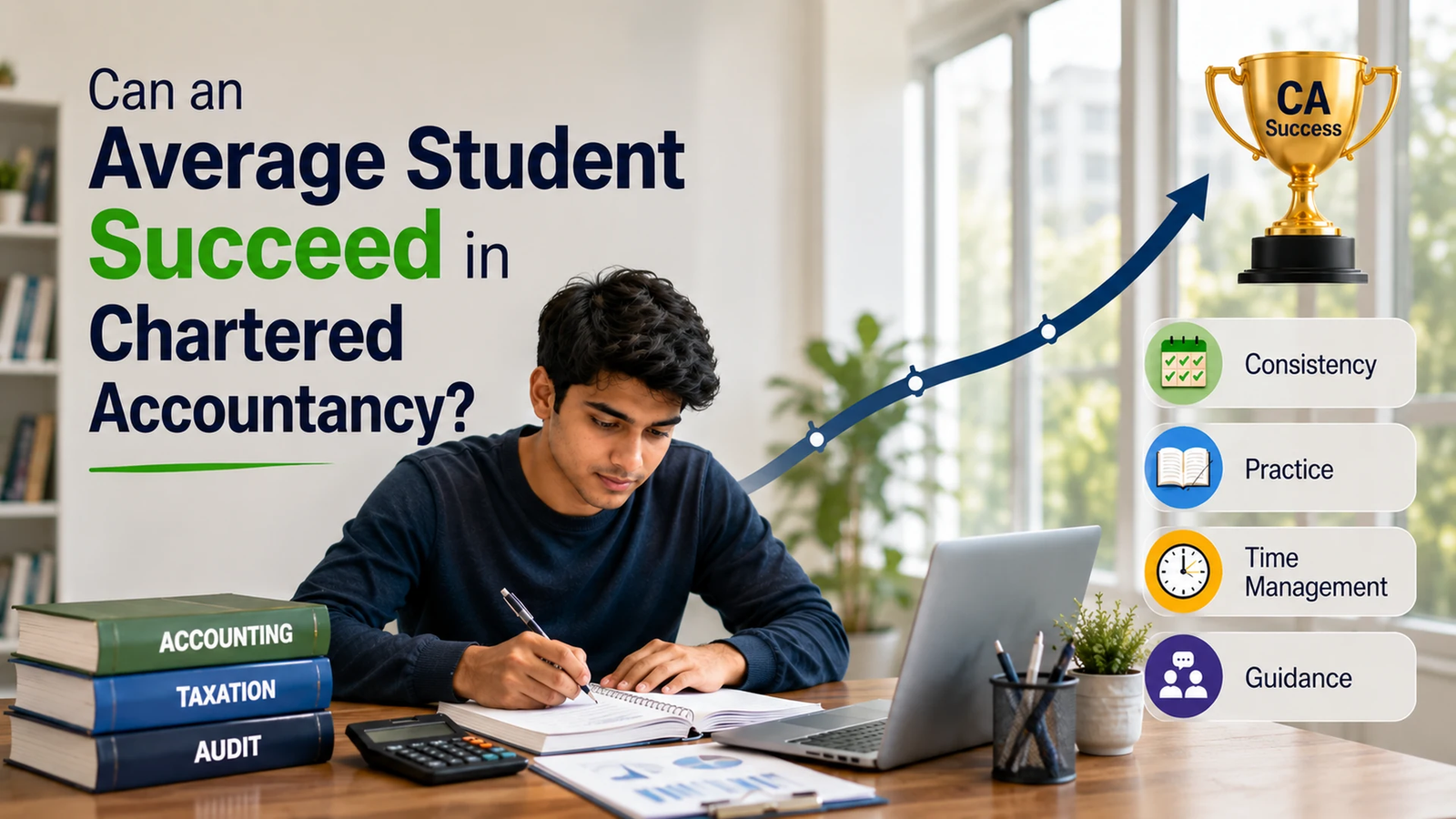
Yes, an average student can succeed in Chartered Accountancy (CA). Being an average student in school or +2 does not automatically mean you lack the ability to complete a professional course like CA.
Past grades show how you performed at a particular stage of your education. They do not tell the whole story about your discipline, interest, learning ability, or how seriously you will approach your studies in the future.
When considering CA for average students, the more useful question is not, “Was I a topper?” It is, “Am I prepared to study consistently, understand concepts, practise regularly, and improve when I make mistakes?”
CA is challenging, and it should not be presented as an easy course. But students do not need to begin as academic toppers. Consistency, conceptual understanding, time management, practice, and proper guidance can make a significant difference throughout the CA journey.
Does CA Require Exceptional Academic Performance?

Exceptional school grades can provide a strong academic foundation, but they are not the only indicator of whether someone can succeed in CA.
ICAN’s current Chartered Accountancy program is structured into Foundation, Application, and Advisory levels. The curriculum progressively develops knowledge in areas including accounting, business and finance, assurance, information systems, law, taxation, audit, financial management, and other professional areas.
The official ICAN FAQ currently states that students who have completed or appeared in Grade 12, 10+2, PCL, A-Level, CBSE, or an equivalent examination may apply for Foundation Level, subject to the applicable academic requirements.
What matters after entering the course is how effectively a student develops the knowledge and skills required at each stage.
School Grades Do Not Fully Measure Ability
School and +2 results reflect previous academic performance, but they cannot completely measure a student’s future learning capacity.
There can be many reasons why a student receives average marks. Some students may not have found an effective study method. Others may have lacked proper guidance, struggled with particular subjects, or simply not taken their earlier studies seriously enough.
A professional course can be different.
When students become interested in accounting, finance, taxation, auditing, or business, they may approach their education with greater purpose than they did in school.
Being an average student, therefore, should not be confused with being incapable of learning.
CA Requires Understanding, Not Only Memorisation
One of the biggest mistakes a CA student can make is depending heavily on memorisation.
CA requires students to understand concepts and know how to apply them. The current ICAN curriculum includes technical and analytical areas such as accounting, assurance, taxation, law, financial management, audit, and business-related subjects.
For example, memorising a solution to one accounting problem may help with that exact question. If the question is presented differently in the exam, students must rely on their understanding of the concept rather than a memorised solution.
The same principle applies to theory. Understanding why a law, audit procedure, or taxation rule applies is more useful than remembering sentences without understanding their meaning.
Basic Abilities Needed to Study CA
Students do not need to possess extraordinary abilities before beginning CA. However, some basic skills will make the learning process easier:
- Basic numerical ability
- Reading and interpretation skills
- Interest in accounting, finance, or business
- Willingness to practise regularly
- Ability to follow a study routine
- Patience when learning difficult concepts
- Willingness to ask for help when necessary
More importantly, these abilities are not fixed. They can be strengthened through study, practice, feedback, and experience.
Academic Performance vs Learning Attitude
Consider two students.
One consistently achieved high marks in school but begins CA with irregular attendance, limited practice, and last-minute preparation.
Another student had average school grades but attends classes regularly, revises each week, solves questions, analyses mistakes, and asks for clarification when something is unclear.
Previous marks favour the first student. Current learning behaviour favours the second.
That does not mean every disciplined average student will automatically pass or every previous topper will struggle. It shows why past grades alone are a poor predictor of future performance.
Once a student enters CA, how they prepare becomes more important than the label they carried in school.
Why Average Students Can Still Perform Well in CA
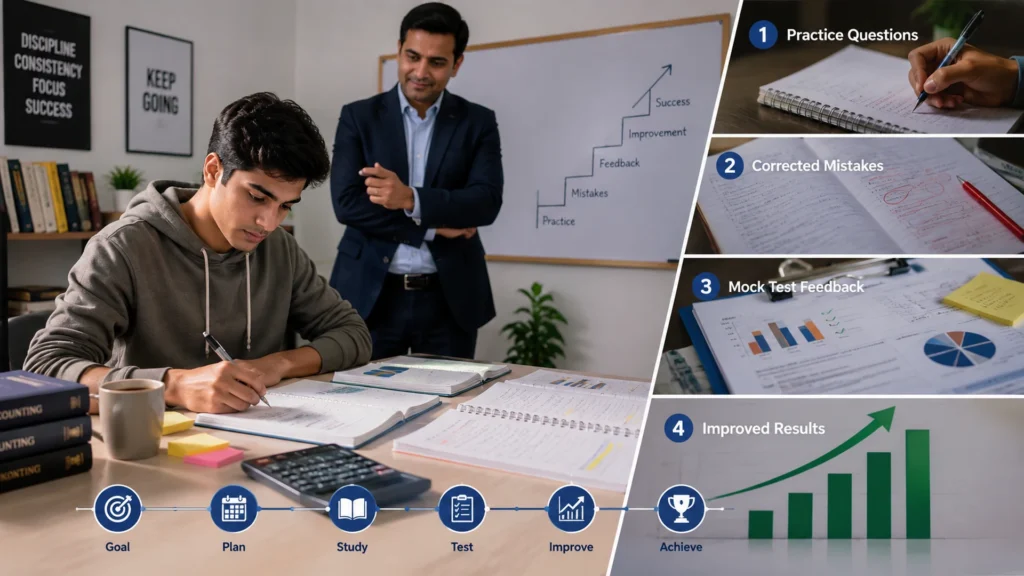
CA gives students time to develop academically and professionally.
No student is expected to understand advanced accounting, taxation, audit, or financial concepts before learning them. The course itself is a process of building that knowledge progressively.
The advantage comes from responding properly when the material becomes difficult.
Consistency Can Be More Important Than Intelligence
CA involves a substantial amount of material, which makes last-minute preparation risky.
A student who studies for a manageable amount of time regularly gets repeated exposure to concepts. Difficult chapters become more familiar, revision becomes easier, and problems can be identified before the examination approaches.
On the other hand, studying intensely only when an exam is close often leaves little time to correct weak concepts.
Consistency does not mean studying all day. It means repeatedly doing the work that needs to be done.
Students Can Improve One Step at a Time
A student may find accounting difficult during the first few weeks. Another may struggle with law or taxation. That initial difficulty should not immediately be interpreted as evidence that CA is unsuitable for them.
Learning usually develops in stages.
Classroom learning introduces the concept. Self-study reinforces it. Question practice tests whether it has actually been understood. Feedback identifies what remains unclear. Revision then strengthens retention.
Progress may feel slow at first, but repeated exposure can turn an unfamiliar topic into a manageable one.
For average students studying CA, focusing on steady improvement is usually more productive than expecting perfection from the beginning.
Mistakes Help Students Find Their Weak Areas
A wrong answer is useful when the student understands why it was wrong.
Mistakes may reveal:
- A concept that was misunderstood
- A calculation error
- Weak answer presentation
- Poor time management
- Incomplete revision
- A chapter that needs additional practice
This is why assignments, unit tests, past questions, and mock examinations should not be treated simply as opportunities to collect marks.
Their greater value is diagnostic.
If a student receives a low mark in a mock examination and carefully analyses the reasons, the test has identified problems while there is still time to correct them.
Proper Guidance Can Make Difficult Subjects More Manageable
Independent study is important, but students do not always recognise their own misunderstandings.
A knowledgeable teacher can explain a difficult concept differently, show where a calculation went wrong, identify weaknesses in answer presentation, and guide students toward more effective preparation.
Structured assessment can also help.
Prime CA, for example, states that its CA preparation system includes weekly or unit tests, mock tests in examination settings, revision classes, study notes containing past questions, and faculty support.
For a student who struggles to organise preparation independently, this kind of structure can provide useful checkpoints. It is not a substitute for personal effort, but it can make that effort more focused.
Average Students Can Develop Strong Discipline
Some students become more serious precisely because they know they cannot depend on natural academic strength alone.
They prepare before classes, practise additional questions, revise regularly, and pay closer attention to their weak areas.
Over time, those behaviours become discipline.
And in a demanding professional course, discipline is a more useful long-term asset than relying entirely on previous academic achievement.
Skills That Can Matter More Than School Grades in CA

The skills needed for CA extend beyond the ability to score well in school examinations.
Self-Discipline
Motivation changes from day to day. A student may feel highly motivated at the beginning of the course and exhausted several months later.
Self-discipline keeps preparation moving when motivation is low.
That means attending classes consistently, completing assignments, following a study schedule, reducing unnecessary distractions, and studying even when the subject is not particularly enjoyable.
Time Management
CA students have to manage classes, self-study, practice, revision, and eventually different professional responsibilities depending on their stage of study.
Good time management means deciding what deserves attention first.
A student who is weak in one subject may need to allocate more time to it instead of dividing every study session equally. Weekly targets can also be more practical than trying to complete an unrealistic number of hours every day.
Conceptual Understanding
Strong concepts make later learning easier.
Students should focus not only on finding the correct answer but also on understanding the reasoning behind it.
Why does this method work?
Why does this rule apply?
What would change if the facts of the question changed?
Questions like these encourage deeper learning and reduce dependence on memorised solutions.
Problem-Solving Ability
Problem-solving improves through practice.
Students should attempt questions before looking at solutions, review every incorrect step, and understand whether the problem came from the concept, calculation, interpretation, or examination technique.
Over time, this process makes unfamiliar questions less intimidating.
Patience and Resilience
Not every test will go well.
A difficult paper, poor mock result, or unsuccessful attempt can be discouraging. But one result should be analysed in context rather than treated as a permanent judgment of ability.
Resilience in CA means identifying what went wrong, adjusting the preparation method, and continuing with a clearer plan.
Communication and Answer-Presentation Skills
Knowing the subject and communicating that knowledge in an examination are related but different skills.
Students should learn to present answers logically, show necessary working steps, use appropriate headings where useful, and allocate examination time according to the marks available.
This becomes particularly important in descriptive and application-based questions.
Self-Evaluation
Students who evaluate their own preparation honestly can make better study decisions.
After a test, instead of only looking at the final mark, ask:
- Which subjects are improving?
- Which chapters remain weak?
- Am I making conceptual or careless mistakes?
- Am I completing papers within the available time?
- Which mistakes keep repeating?
Tracking these patterns makes improvement more deliberate.
Study Habits That Improve CA Exam Performance

Good study habits cannot guarantee a particular examination result, but they can make preparation more organised and effective.
Create a Realistic Daily Study Plan
A study plan should be demanding enough to create progress but realistic enough to follow.
Rather than writing “study accounting for five hours,” break the task into something measurable, such as completing one concept, solving a specific set of questions, and reviewing the mistakes.
Large chapters also become easier to manage when divided into smaller topics.
Revise Every Subject Regularly
Learning something once is rarely enough.
Review important concepts after class, schedule weekly revision, and revisit older chapters periodically instead of waiting until the final weeks before the examination.
Short notes, summaries, formula sheets, and personal mistake logs can make later revision faster.
Practise Past Questions and Mock Tests
Knowing the syllabus is different from being able to perform under examination conditions.
Past questions and mock tests help students practise:
- Question interpretation
- Time management
- Calculation accuracy
- Answer structure
- Decision-making under time pressure
After completing a mock test, spend time reviewing it. Simply taking more tests without understanding previous mistakes provides limited improvement.
Focus on Weak Subjects Early
Students often spend more time on subjects they feel confident about.
That can create a dangerous cycle in which strong subjects become stronger while weak subjects receive less attention.
Identify difficult chapters early and work on them before examination pressure increases.
If repeated practice still does not solve the problem, seek clarification rather than continuing with the same unsuccessful method.
Use Active Learning Methods
Reading is useful, but reading alone can create the illusion that a topic has been mastered.
Active learning requires the student to retrieve or apply information.
Try solving a question without looking at the answer, explaining a concept in your own words, summarising a chapter from memory, or discussing a difficult problem with a teacher or classmate.
If you cannot explain the concept clearly, you probably need another round of study.
Balance Theory and Practical Subjects
Some students spend most of their time on numerical subjects because progress feels measurable. Others prefer theory because they find calculations difficult.
Both approaches create gaps.
CA requires students to work across different types of subjects, so preparation should include both conceptual/theoretical learning and numerical/application-based practice.
Maintain Physical and Mental Well-Being
More study hours do not automatically mean better preparation.
Poor sleep, constant stress, and studying without suitable breaks can reduce concentration and make learning less efficient.
Maintain a sustainable routine, get adequate rest, take reasonable breaks, and avoid measuring your progress constantly against other students.
Different students learn at different speeds.
Stay Consistent Until the Examination
One productive week cannot compensate for months of irregular preparation.
The habits that help most are usually simple: attend classes, study what was taught, revise, practise, analyse mistakes, and repeat the process.
When motivation falls, reduce unnecessary distractions and focus on the next manageable task rather than thinking about the entire CA journey at once.
Conclusion
So, can an average student succeed in Chartered Accountancy?
Yes. But being an average student does not make CA easy, and motivation alone is not enough.
Previous school or +2 marks do not completely determine what a student can achieve in professional education. What matters after beginning CA is the ability to build strong concepts, practise consistently, manage time, learn from mistakes, respond to setbacks, and continue improving.
Proper academic guidance can make that process more organised. Prime CA provides CA exam preparation support through structured classes, faculty guidance, weekly and unit assessments, mock examinations, past-question materials, and revision classes.
These resources can support preparation, but the student’s own effort remains essential.
If you consider yourself an average student, do not make the decision based only on the marks you received in the past. Look more carefully at your interest in the field, your willingness to work consistently, and whether you are prepared for the discipline that Chartered Accountancy requires.
Being average at the starting point does not decide where you will finish.
Frequently Asked Questions
Can an Average Student Pass CA Exams?
Yes. Average students can pass CA examinations if they build strong concepts, practise regularly, revise consistently, and correct weaknesses identified through tests and feedback. Past school grades alone do not determine future CA examination performance.
Do School or +2 Grades Matter for Studying CA?
Grades matter for meeting the applicable admission requirements, but they do not by themselves determine whether a student will eventually succeed in CA. ICAN currently publishes specific eligibility requirements for entry into its CA program, so students should always verify the latest criteria directly with ICAN before applying.
Is CA Difficult for Students Who Are Weak in Mathematics?
CA involves numerical work, particularly in accounting, financial management, management accounting, and related areas, but it is not simply an advanced mathematics course. Students who are uncomfortable with numbers may need additional practice, especially with calculations and numerical interpretation. Strong conceptual understanding and regular problem-solving matter more than being naturally gifted at mathematics.
How Many Hours Should a CA Student Study Each Day?
The ideal amount of daily study time varies from one CA student to another. The appropriate amount depends on the student’s level, class schedule, strengths, weaknesses, and proximity to examinations. A focused and sustainable routine is usually more useful than occasionally studying for very long hours.
What Study Habits Help Students Succeed in CA?
Regular revision, question practice, mock examinations, active learning, reviewing mistakes, focusing on weak topics, and following a realistic study schedule can all improve CA preparation. Students should also adjust their study method based on their performance instead of repeatedly using a strategy that is not working.
Can Students From a Non-Commerce Background Study CA?
Students from different academic backgrounds may be able to enter the CA program if they satisfy ICAN’s applicable eligibility requirements. Those without a previous accounting background may need additional effort initially to become comfortable with fundamental accounting and business concepts. Students should check the latest entry requirements published by ICAN before registration.
Is Coaching Necessary for an Average CA Student?
Coaching is not a guarantee of success, nor is it the only way to prepare. However, structured classes can help students who benefit from teacher explanations, regular assessments, doubt clarification, revision schedules, and a more organised study environment. The value depends on how effectively the student uses that support.
What Should a Student Do After Scoring Low in a CA Mock Test?
Do not look only at the final score. Review each mistake and determine whether it came from weak concepts, insufficient revision, calculation errors, poor question interpretation, answer presentation, or time management. Then change the study plan accordingly and practise similar questions again. A mock test is most useful when its mistakes influence what you study next.