Becoming a Chartered Accountant is a respected career choice for students interested in accounting, auditing, taxation, finance, and business management. Chartered Accountants help businesses, government organisations, and individuals maintain accurate financial records, comply with tax and regulatory requirements, examine financial statements, manage financial risks, and make informed business decisions.
To become a CA in Nepal, students must follow the professional qualification pathway administered by the Institute of Chartered Accountants of Nepal, commonly known as ICAN. ICAN is the autonomous professional body authorised to regulate the accountancy profession and Chartered Accountancy education in Nepal.
The complete process involves meeting ICAN’s eligibility requirements, registering at the appropriate entry level, passing the required examinations, completing practical training, fulfilling applicable professional development requirements, and applying for ICAN membership.
Students register for the CA course directly through ICAN. However, many also join a preparation institute for structured academic support. Prime CA supports students preparing for ICAN examinations through regular classes, experienced faculty guidance, study materials, assessments, mock examinations, and examination-focused preparation.
Who Is Eligible to Study CA in Nepal?

Students from different educational backgrounds can study CA in Nepal. The course is not limited to students who studied accounting or management at school.
Students from management, science, humanities, law, and other recognised academic streams may apply, provided they meet the eligibility requirements announced by ICAN.
Academic Requirements After Grade 12
Students can normally register for the Foundation Level after completing Grade 12 or an equivalent qualification from a recognised academic institution.
Accepted academic qualifications may include:
- Grade 12 or 10+2
- Proficiency Certificate Level
- A-Level
- CBSE
- Other qualifications recognised as equivalent to Grade 12
For Foundation Level registration, students must generally have secured at least a GPA of 2.00, C grade, 40% marks, or an equivalent result in Grade 12 or an equivalent examination.
Students who have appeared in their Grade 12 or equivalent examination and are waiting for their results may be able to apply for provisional registration. They must later submit proof that they passed the examination within the period specified by ICAN.
Provisional registration allows students to begin the registration process before their final results are published. However, provisional registration does not automatically become permanent. Students must submit the required academic documents and meet ICAN’s final eligibility conditions within the stated deadline.
Can Students from Any Stream Study CA?
Yes, students from different academic streams can study Chartered Accountancy in Nepal.
Applicants may come from:
- Management
- Science
- Humanities
- Law
- Other recognised academic streams
A management or accounting background can be helpful because students may already understand basic concepts related to accounting, economics, business, and finance. However, previous accounting knowledge is not compulsory.
The Foundation Level is designed to introduce the core knowledge students need before progressing to more advanced CA subjects. Therefore, students from science, humanities, law, and other streams can develop their accounting knowledge after joining the course.
Students from non-management backgrounds may need to spend additional time learning accounting principles and financial terminology during the beginning stage. However, with regular study, classroom guidance, and consistent practice, their academic stream should not prevent them from progressing in CA.
Eligibility for Bachelor’s Degree Holders
Students who have completed a bachelor’s or master’s degree may qualify for a different entry route.
Under ICAN’s current eligibility framework, graduates and postgraduates who have secured at least 50% aggregate marks or an equivalent result may be eligible to register directly for the Application Level. Graduates with lower marks may need to enter through the Foundation Level.
Students awaiting the final results of their bachelor’s or master’s degree may also be allowed to register provisionally, subject to the conditions stated by ICAN.
A graduate’s entry route may depend on:
- The degree completed
- The academic institution
- Aggregate marks or GPA
- Equivalence requirements
- The syllabus applicable during registration
- Current ICAN admission rules
Graduates should check the latest ICAN admission notice before selecting an entry level or paying a registration fee. This helps prevent delays caused by choosing an incorrect registration category.
Is There an Entrance Exam or Age Limit?
ICAN’s current eligibility information does not specify a separate entrance examination for students registering at the Foundation Level. Students who satisfy the required academic criteria can apply through ICAN’s official registration process.
There is also no fixed age limit for joining the Foundation Level. Students may begin the CA course after Grade 12, after completing another degree, or after gaining professional experience, provided they meet the applicable academic requirements.
However, the absence of an entrance examination should not be taken to mean that CA is easy. The course involves detailed theoretical study, professional examinations, practical training, and several years of disciplined preparation.
How to Register for the CA Course Through ICAN
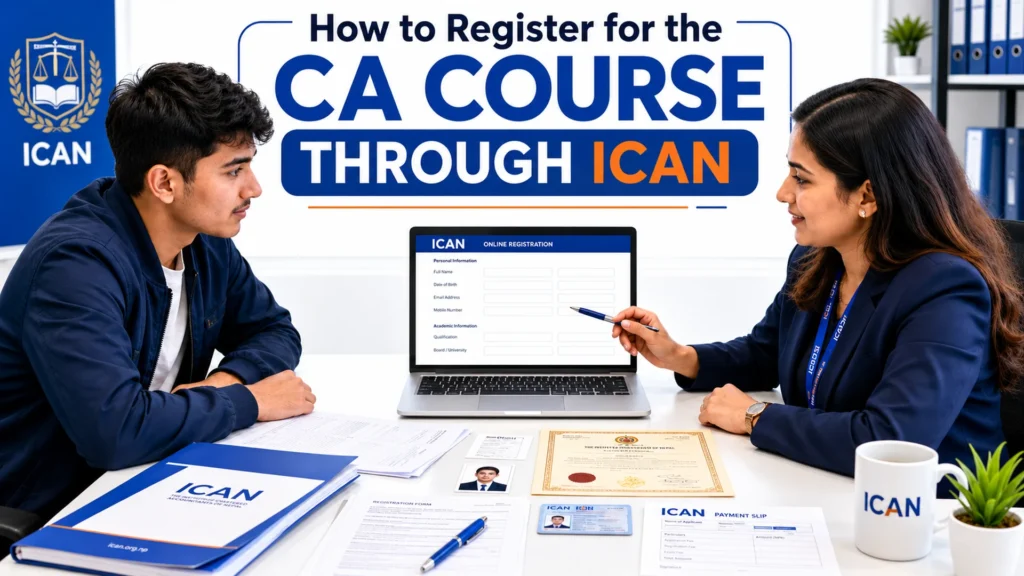
Students must officially register with ICAN to enter Nepal’s Chartered Accountancy qualification pathway. Joining classes at a CA preparation institute does not replace official registration with ICAN.
ICAN registration creates the student’s formal academic record. It enables the student to complete the required study period, apply for examinations, receive results, register for practical training, and progress through the CA qualification.
Choose the Correct Entry Level
Students who enter the CA programme after completing Grade 12 generally start their qualification journey at the Foundation Level.
Before applying, students should confirm:
- Whether their academic qualification is recognised
- Whether they meet the required marks or GPA
- Whether they need full or provisional registration
- Whether they qualify for graduate entry
- Which syllabus applies to their admission session
- Which CA level they are eligible to join
A student entering after Grade 12 will generally select the Foundation Level. An eligible bachelor’s or master’s degree holder may be able to register directly for the Application Level.
Selecting the wrong entry level can delay the application or require additional documentation. Students should therefore read the latest ICAN registration notice carefully before completing the application.
Complete the Online ICAN Registration
ICAN provides an online system for student registration, enrolment, document submission, and other student services. Current ICAN enrolment notices direct applicants to complete registration through the Institute’s official online enrolment portal.
The general registration process includes the following steps:
- Visit the official ICAN student registration or enrolment portal.
- Create a student account using accurate personal details.
- Select the appropriate CA level and registration category.
- Complete the online application form.
- Upload the required identification and academic documents.
- Pay the applicable registration fee.
- Review all information before submitting the application.
- Save the application number, payment receipt, and confirmation details.
Students should make sure that their name, date of birth, address, academic information, and identification details are consistent across all documents.
Even a small spelling difference between a citizenship certificate and an academic transcript may create difficulties during verification.
Applicants should also provide an active phone number and email address. ICAN may use these details to send registration updates, examination notices, deadlines, and other academic information.
Documents Required for ICAN Registration
The required documents may vary depending on whether the student is entering after Grade 12, awaiting final results, or applying through the graduate route.
Commonly requested documents may include:
- Recent passport-size photograph
- Scanned signature
- Citizenship certificate, birth certificate, or passport
- SEE transcript and certificate
- Grade 12 transcript and certificate
- Grade 12 admit card for provisional applicants
- Bachelor’s or master’s academic documents for graduate applicants
- Equivalence certificate where applicable
ICAN uses a centralised student system through which applicants can submit registration information and upload supporting documents.
All uploaded documents should be clear, complete, and readable. Blurred photographs, cropped certificates, missing pages, or incorrect file formats may delay verification.
Students should confirm the latest document list through ICAN’s current registration notice because requirements can differ according to the applicant’s entry route and admission session.
Registration Fees and Admission Deadlines
Students must pay the registration fee prescribed by ICAN for their selected level.
Registration fees, examination fees, training charges, and other costs may be revised. Students should therefore verify the latest fee notice instead of depending on an old blog, social media post, brochure, or screenshot.
ICAN announces registration and examination eligibility deadlines through official notices. Students should verify the latest deadline before submitting their application.
The required registration period can also depend on the level. For example, Foundation and Application students must generally complete the prescribed study period before becoming eligible for their examinations.
Applicants should check:
- Registration opening dates
- Registration closing dates
- Required study periods
- Examination eligibility dates
- Applicable registration fees
- Examination fees
- Payment instructions
- Provisional document deadlines
- Late submission conditions, where available
Missing an important registration or examination deadline may require a student to wait until a later examination session.
Prepare for CA Classes After Registration
Students should understand the difference between registering with ICAN and joining a CA preparation institute.
ICAN registration officially enrols the student in the Chartered Accountancy qualification. ICAN controls eligibility, examinations, practical training requirements, academic progression, results, and membership.
Joining a CA institute provides academic preparation for ICAN examinations. A preparation institute may provide classroom teaching, subject guidance, study materials, regular assessments, revision classes, mock examinations, and academic counselling.
Prime CA offers examination preparation classes for students pursuing the ICAN Chartered Accountancy course. Its academic system includes regular assessments, weekly or unit tests, mock examinations, subject guidance, and preparation support for different CA levels.
After completing registration, students should begin classes and self-study without unnecessary delay. CA subjects become more difficult to manage when students postpone their preparation until the examination approaches.
What Levels Must You Complete to Become a CA?
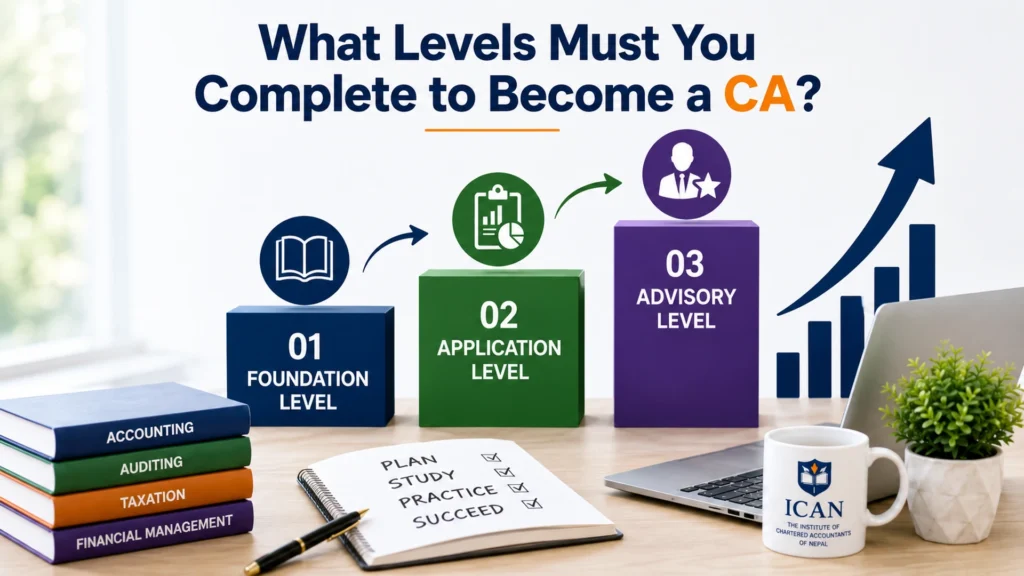
Under ICAN’s new course structure, the Chartered Accountancy qualification is organised into three stages:
- Foundation Level
- Application Level
- Advisory Level
These stages gradually develop technical knowledge, analytical ability, practical skills, professional judgement, and business advisory competence.
ICAN has introduced the new syllabus through a staged implementation process. Therefore, some students registered under the previous system may still be completing CAP-I, CAP-II, or CAP-III requirements. New students should confirm which syllabus applies to their registration session.
Foundation Level
The Foundation Level is the starting stage for most students joining CA after Grade 12.
It develops introductory knowledge in areas such as:
- Accounting
- Business
- Finance
- Assurance
- Information systems
- Business law
- Taxation
The four Foundation Level papers are:
- Accounting
- Business and Finance
- Assurance and Information Systems
- Law and Taxation
The Foundation Level has an indicated duration of six months. Students must complete the required study period and satisfy ICAN’s examination conditions before appearing in the final examination.
Students should focus on understanding the basic principles rather than memorising answers. A strong foundation in accounting, business, law, and taxation makes the Application and Advisory levels easier to manage.
Regular numerical practice is especially important in accounting and finance-related topics. For law and taxation, students should understand the meaning and application of rules instead of only memorising definitions.
Application Level
The Application Level is the second stage of the CA qualification.
It builds on the knowledge developed at the Foundation Level and requires students to apply accounting, financial, legal, taxation, auditing, and business concepts to more complex situations.
This level develops knowledge and skills related to:
- Financial reporting
- Management accounting
- Business strategy
- Taxation
- Corporate and commercial law
- Auditing and assurance
- Financial management
- Business decision-making
Students entering through the Foundation route must pass the required Foundation examination and satisfy ICAN’s progression conditions. Eligible graduates may be able to register directly for the Application Level.
The Application Level has an indicated duration of nine months.
At this stage, students must do more than remember formulas, laws, and accounting rules. They need to understand how to apply those concepts to practical questions and professional situations.
Written practice also becomes more important. Students must present calculations, explanations, legal reasoning, audit observations, and professional conclusions clearly within the examination time.
Practical Training and Articleship
Practical training, commonly known as articleship, is an essential part of the CA qualification.
Articleship allows students to apply classroom knowledge in real professional situations under an approved training arrangement.
During practical training, students may gain experience in:
- Maintaining and examining accounting records
- Preparing financial statements
- Performing audit procedures
- Reviewing internal controls
- Preparing tax calculations and returns
- Supporting legal and regulatory compliance
- Communicating with clients
- Preparing audit working papers
- Drafting financial reports
- Assisting with business and financial advisory work
Practical training helps students understand that Chartered Accountancy involves more than passing examinations. A professional accountant must also communicate clearly, meet deadlines, maintain confidentiality, follow ethical standards, and exercise sound professional judgement.
ICAN’s published articleship requirements provide for three years of practical training under the applicable rules.
Students must follow ICAN’s requirements related to articleship registration, approved training arrangements, supervision, leave, reporting, record keeping, and completion.
Training records should be maintained carefully. Missing reports, incomplete documentation, excessive leave, or delayed articleship registration can affect the completion date and delay the membership process.
Advisory Level
The Advisory Level is the final academic stage of the CA qualification.
At this level, students are expected to combine technical knowledge with the professional experience gained during practical training.
The Advisory Level focuses on areas such as:
- Advanced financial reporting
- Strategic decision-making
- Advanced assurance
- Business risk evaluation
- Professional judgement
- Financial and business advisory services
- Integration of accounting, taxation, law, finance, and strategy
- Ethical and professional responsibilities
Questions at the final level may require students to analyse complex situations, identify important financial or legal issues, assess different options, and provide professionally supported recommendations.
Students therefore need strong conceptual knowledge, practical exposure, examination-writing skills, and effective time management.
The Advisory Level is closely connected with the student’s practical training period and represents the final stage before completing the academic requirements of the CA qualification.
Passing the Final Requirements and Applying for Membership
Passing the final academic examinations is an important achievement, but it does not automatically complete every requirement for becoming an ICAN member.
Students must generally:
- Pass the examinations required under the applicable syllabus
- Complete the required articleship training
- Complete applicable IT training
- Complete required professional development programmes
- Fulfil ICAN’s administrative requirements
- Submit the necessary documents
- Meet the conditions for membership
- Apply for ICAN membership
ICAN states that candidates qualifying through its CA course must pass the final-level examination and complete three years of articleship training to meet the main eligibility conditions for Chartered Accountant membership.
Membership and a Certificate of Practice are not the same. A person may qualify as an ICAN member after meeting the membership requirements. However, a member who wants to provide certain professional services independently may need to satisfy additional requirements for a Certificate of Practice.
How Long Does It Take to Qualify as a CA in Nepal?
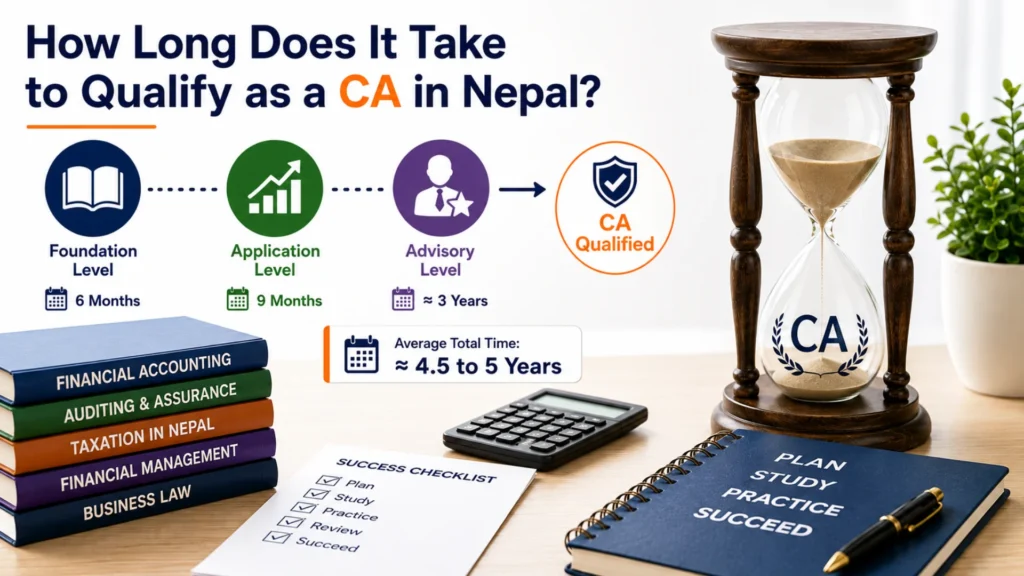
The time required to become a CA in Nepal depends on the student’s entry route, registration timing, examination performance, practical training, and completion of professional requirements.
Two students who begin the course at the same time may qualify on different dates. One may pass every examination according to schedule, while another may need additional attempts or experience delays in registration or articleship.
Expected Duration of Each CA Level
The indicated durations under the current ICAN course structure are approximately:
- Foundation Level: Six months
- Application Level: Nine months
- Advisory Level: Approximately three years
The Advisory stage is closely connected with the practical training requirements of the CA course.
These durations represent the prescribed course periods. They do not guarantee that every student will complete the qualification within the same timeline.
Students must also consider:
- Examination schedules
- Result publication dates
- Academic progression requirements
- Articleship registration
- Practical training completion
- Mandatory professional programmes
- Membership application procedures
A delay of one examination session can add several months to the total duration.
Average Time Needed to Complete the CA Course
A student who registers on time, passes examinations according to schedule, completes articleship without interruption, and fulfils the required professional programmes may qualify in approximately four and a half to five years.
The exact period can vary depending on:
- The student’s entry route
- Examination results
- Examination session timing
- Articleship progress
- IT and professional training requirements
- Membership documentation and processing
- Changes in the applicable syllabus or regulations
Graduates entering directly at the Application Level may follow a shorter academic route than students entering after Grade 12. However, they must still complete the practical and professional requirements prescribed for their registration category.
Factors That Can Extend the Course Duration
Several factors can increase the time required to complete the CA qualification.
Unsuccessful examination attempts
Students who do not pass a required paper or group may need to prepare again and wait for the next available examination session.
Delayed ICAN registration
Missing a registration deadline or completing registration late may prevent a student from appearing in the intended examination.
Missed examination sessions
Illness, incomplete examination forms, personal circumstances, or poor preparation may cause a student to miss an examination session.
Incomplete practical training
Extended leave, delayed articleship registration, incomplete records, or failure to meet training requirements can affect the practical training completion date.
Incomplete tests or professional programmes
Students may need to complete IT training, professional development courses, pre-tests, or other programmes prescribed by ICAN.
Difficulty balancing articleship and study
Articleship provides valuable professional experience, but students must manage office responsibilities alongside classes, revision, self-study, and examination preparation.
Weak understanding of earlier subjects
CA subjects are interconnected. Weak knowledge of accounting, taxation, audit, finance, or law at an earlier level can make advanced subjects more difficult.
How Students Can Complete the Course on Time
Completing CA on schedule requires consistency, planning, and regular practice.
Students should:
- Follow a realistic daily and weekly study timetable.
- Attend classes regularly.
- Begin studying each subject from the start of the session.
- Review topics shortly after they are taught.
- Practise calculations and written answers consistently.
- Solve previous examination questions.
- Take mock examinations under timed conditions.
- Review mistakes after every test.
- Revise weak topics regularly.
- Keep articleship records updated.
- Follow ICAN notices and deadlines.
- Ask faculty members for help when concepts are unclear.
- Focus on understanding concepts instead of memorising complete answers.
Mock examinations can help students evaluate their subject knowledge, writing speed, answer presentation, time management, and ability to complete a paper under examination conditions.
A CA institute can provide teaching, resources, and direction, but students remain responsible for their own progress. Regular self-study and revision are necessary even when a student attends classes consistently.
Conclusion
The process of becoming a Chartered Accountant in Nepal begins with checking your eligibility and selecting the correct entry route. Students must then register with ICAN, complete the Foundation, Application, and Advisory levels, pass the required examinations, undergo practical training, complete applicable professional programmes, and fulfil ICAN’s membership requirements.
CA is a demanding professional qualification that requires discipline, patience, ethical responsibility, and long-term commitment. Students who study consistently, practise examination questions, manage their articleship carefully, and follow ICAN deadlines can progress through the course more confidently.
Prime CA supports students seeking structured ICAN examination preparation through regular classes, experienced faculty guidance, study materials, assessments, mock examinations, and academic support.
Contact Prime CA for admission counselling, eligibility guidance, and information about upcoming Chartered Accountancy classes.
Frequently Asked Questions
Can I study CA after Grade 12 in Nepal?
Yes. Students who have completed Grade 12 or an equivalent qualification and meet ICAN’s minimum academic requirements can register for the Foundation Level. Students awaiting their final Grade 12 results may also be eligible for provisional registration.
Can science and humanities students study CA?
Yes. Students from science, humanities, management, law, and other recognised academic streams can study CA. Previous accounting knowledge can be helpful, but it is not compulsory.
Is an entrance examination required to join CA in Nepal?
ICAN’s current eligibility information does not specify a separate entrance examination for Foundation Level registration. Eligible students can apply through ICAN’s official registration system.
How many levels are there in the CA course in Nepal?
The current ICAN course structure includes three stages: Foundation Level, Application Level, and Advisory Level. Some students registered under the earlier syllabus may still be completing the previous CAP structure during the transition period.
How many years does it take to become a CA in Nepal?
and other requirements without interruption may qualify in approximately four and a half to five years.
Is coaching compulsory for CA students?
No. Joining a preparation institute is not compulsory under ICAN. However, structured classes, experienced faculty guidance, regular assessments, mock examinations, study materials, and academic support may help students prepare more effectively.